I’m a CTO who works from home in Fergus, Ontario, and my internet connection is the whole office: client calls, deploys, a wife running her half of the agency across the hall, and a kid whose cartoons stream in the background of all of it. When the internet goes down in this house, the whole business goes down with it.
So when I tell you I moved that connection to oxio, a small indie ISP most people have never heard of, understand that I didn’t do it casually.
This is my oxio internet review: why I left Cogeco, how the switch actually went, the speed test I wasn’t expecting, and the question everyone really wants answered, which is whether the cheap indie option is secretly worse.
Why I left Cogeco
The big carrier playbook is the same everywhere in Canada, and Cogeco ran it on me by the book.
I signed up at a promotional rate of $60 a month. A while later the bill went to $70. I assumed that was the two-year term ending and shrugged; that’s the deal you make with a promo. It wasn’t. It was a regular rate increase, the kind they mail you a paragraph about, and the promo was still very much running.
Then the promo actually ended, and the same plan on the same wire went past $100 a month.
That was the month I signed up for oxio. Same wire, same speed tier, $55 a month.
Calling to negotiate is a part-time job. I’ve done the annual “I’d like to cancel” retention-department dance more times than I want to admit, and I was staring down another round of it. I got tired of the dance.
Oxio’s pitch is the opposite: one flat price, no contract, and the number on the website is the number on the bill in year three. As a business model it’s almost suspiciously boring. As a customer it’s exactly what I wanted.
Wait, who is oxio?
Oxio is a Canadian ISP built on the reseller model. They don’t dig their own trenches: they lease access to the same cable infrastructure the incumbents run, under CRTC rules that force the big carriers to wholesale their last mile. The industry term is TPIA. The practical translation, in my case: oxio is Cogeco’s wire with a different company on top of it. Same coax into the house, same node down the street, cheaper bill, and the price is locked.
A note on “indie,” because it’s in the title and people check: oxio started out independent, and Cogeco bought its internet business in 2023. It still runs as its own brand, with its own pricing, its own checkout and its own support, and that’s the part I’m paying for. So yes, I left Cogeco for a company Cogeco owns, and the bill dropped by half. I’m aware of how that sounds.
That one fact reframes the whole “is oxio internet good” question. The physics are identical to the incumbent’s. The network is the same network. What changes is the billing, the support, and the relationship with the company that charges you every month.
The signup
I signed up at order.oxio.ca in about five minutes on a weeknight. Picked the address, picked the 1 Gbps down / 30 Mbps up plan, entered a referral code, done. No phone call. No “let me transfer you to our loyalty department.” No upsell on a TV bundle I didn’t ask for.
Two things stood out:
- The referral program is the only discount. No coupon-code theatre, no fake urgency. One free month for me, one for the person whose code I used. I wrote up how it works (and put my own code up) on my oxio referral code page if you want the free month too.
- They tell you the all-in price. $55 a month for the gigabit plan, modem included, and included means included: there’s no rental line on the bill. What you see during checkout is what you pay.
The install
I have what a polite person would call a complex home network. UniFi gateway, UniFi switches, UniFi access points, VLANs for the office and the kid’s tablet and the smart-home junk that I don’t trust. Every ISP install I’ve ever done involves an hour of convincing the ISP’s box to get out of the way so mine can do its job.
Oxio’s modem showed up already in bridge mode.
I plugged the coax in, plugged my gateway into it, and my whole network came up behind it like nothing had changed. I never opened their app. I never touched their wifi. Nobody came to the house. If you run your own router, that sentence is the entire install review: it slotted in.
If you don’t run your own router, their modem does wifi too, and I have no opinion on it because I never turned it on.
The speeds
I bought 1 Gbps down and 30 Mbps up, which is the same speed tier I had on Cogeco. Here is fast.com from my office the other morning:
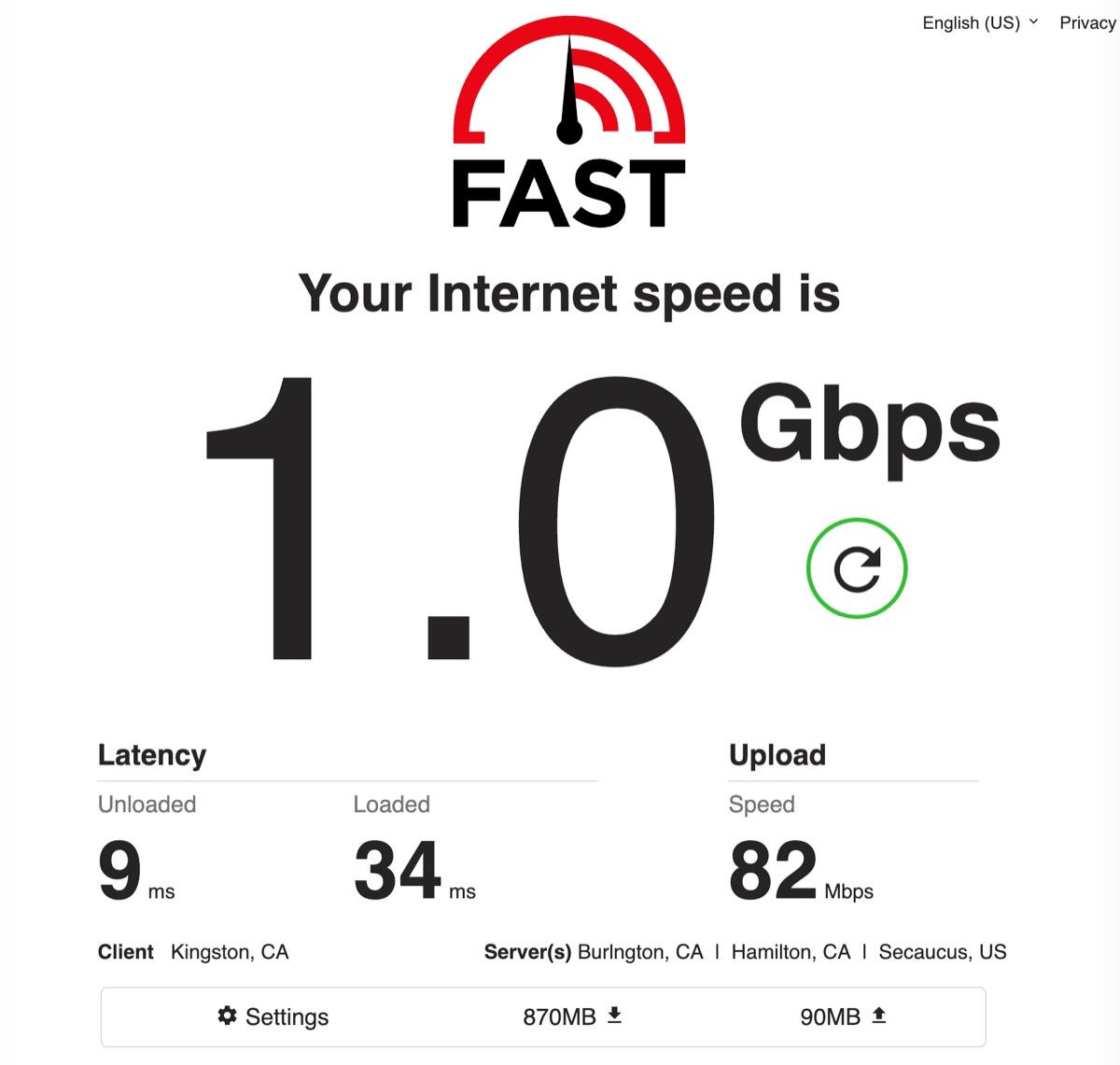
Download is the full gigabit. Latency is 9 ms idle and 34 ms under load, which is fine for calls and fine for the kid’s games.
The number I keep looking at is the upload: 82 Mbps on a plan that promises 30. I bought the same tier I had before, on the same physical line, and the upload nearly tripled. I don’t have a clean explanation. My best guess is that the wholesale provisioning profile oxio uses on Cogeco’s network is more generous than the one Cogeco sold me directly, but I’m speculating and I’m not going to email them to ask in case the answer is “oops.”
For a work-from-home setup, upload is the number that matters. It’s the video call, the git push, the deploy artifact that’s bigger than it has any right to be. Getting nearly three times what I paid for was the best surprise of the whole switch.
(Fast.com also thinks I’m in Kingston, which is a few hundred kilometres from my desk. Geo-IP on a wholesale line is its own comedy. Nothing in the house cares.)
Update, November 10, 2026. Two months in, I ran it again, twice, about ten minutes apart on a Tuesday afternoon, wired both times. Apple’s built-in networkQuality said 852 Mbps down and 58 up. Then fast.com, the same tool as the screenshot above, said 490 Mbps down and 33 up, with latency at 13 ms idle and 16 ms loaded. That second one was prime time in this neighbourhood, and the line shows it: half the download I pay for, and an upload back to roughly the 30 on the plan.
So the screenshot above is the best case, and 490 is what a busy hour looks like. This is the congestion I said I’d watch for. It comes from the node the whole street shares, so oxio inherits it from Cogeco’s network the same way it inherits the good mornings. 490 Mbps is still plenty for calls, deploys and cartoons all at once. But if you’re buying gigabit and expecting gigabit at dinner time, a shared cable line won’t give you that, whoever sends the bill.
So is oxio internet good?
Here’s my framework, and it’s the same one I use when clients ask me to evaluate any vendor: separate the parts that are physics from the parts that are policy.
Physics (same as the incumbent): the cable, the node, the speeds the line can carry. Oxio rides the same infrastructure, so if your neighbourhood has solid cable service, oxio inherits it. If your neighbourhood has congestion problems at 8 p.m., oxio inherits those too. In my case the physics came out slightly ahead on a quiet morning and well behind at prime time. Both sets of numbers are above.
Policy (where oxio actually differs):
- Flat pricing that doesn’t creep. $55 is the bill, indefinitely. No $60 that becomes $70 that becomes $100.
- No contract. Leaving requires no negotiation, which ironically is the best retention strategy I’ve seen.
- Support is chat-first with humans who can actually do things. No phone tree purgatory.
- It’s a smaller company, so an outage on the upstream network still takes you down. The indie layer adds simplicity, not redundancy.
Who shouldn’t switch: if your employer pays your internet bill and you genuinely don’t care what it costs, the incumbent is fine. The wire is the wire.
Who should: anyone doing the annual retention-call dance to keep their bill reasonable. You’re spending real hours to rent a price oxio just gives you.
The verdict so far
Switching ISPs is like switching banks. Everyone complains about theirs, nobody wants to do the paperwork, and the paperwork turns out to be twenty minutes. The free month made trying it a no-risk experiment: my Cogeco plan stayed live while oxio came online, and the first oxio bill was zero dollars.
I’ll update this review as the months stack up. If the flat price holds and the connection stays boring, that’s the best possible outcome. Boring is what you want from infrastructure.
If you’re weighing oxio against another reseller rather than the incumbent: I’ve been a TekSavvy customer twice, and I ranked all three in oxio vs TekSavvy vs Cogeco.
If you want to run the same experiment, my referral code page has the code and the link: first month free for you, one for me, and oxio foots the bill for both.
Oxio FAQ
The questions that keep landing people on this page, answered in one place.
Is oxio internet good?
For me, yes. I pay for 1 Gbps down and 30 Mbps up. On a quiet morning I’ve measured the full gigabit down and 82 Mbps up. At prime time I’ve seen 490 down and 33 up. That swing belongs to the shared cable line, and you’d get it from any provider on it, because the connection is exactly as good as the cable line into your house. The part oxio changes is the bill: $55 flat for gigabit, modem included, no contract.
Is oxio legit?
Yes. The modem showed up, the line came up, and the bill matches the number on the website. If the price is what makes you suspicious, the explanation is boring: there’s no promo rate, so there’s nothing to claw back later.
Who owns oxio?
Cogeco. Cogeco Connexion bought oxio’s internet business in 2023 and has kept it running as a separate brand, with its own pricing, its own checkout and its own support. Which makes my switch a little funny: I left a Cogeco bill for a much cheaper one from a company Cogeco owns. The gap between the two brands is real, though. Same wire into the same house, $55 a month instead of more than $100.
What network does oxio use? Is it fibre?
Oxio runs on the local cable company’s network, so the answer depends on your address. At my house in Fergus, Ontario, that’s Cogeco’s coax. It’s cable internet: fibre to the neighbourhood, coax into the house. It isn’t fibre to the home. Off-peak it still delivers a full gigabit down here.
Does oxio work with your own router?
Yes. The modem arrived already in bridge mode, and my UniFi gateway came up behind it without any configuration on oxio’s side. If you’d rather not run your own gear, the modem does wifi too.
Is there an oxio promo code?
The referral program is the only ongoing discount: your first month free with an existing customer’s code. Mine is on my oxio referral code page, along with where to paste it at checkout.